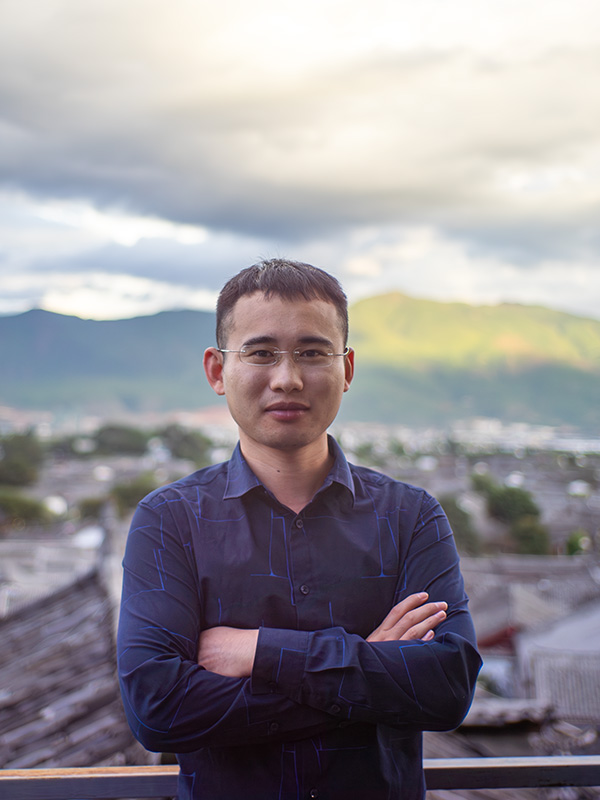
Xingyao Wu
- Qingdao, Shandong, China
- Google Scholar
About me: I am a tenure-track professor specializing in quantum information science, with core research interests spanning quantum algorithms, circuit optimization, error correction, and physics-informed method. My work bridges the gap between fundamental theoretical physics and applied quantum machine learning, focusing on the scalability of quantum simulations and the architectural design of high-performance quantum software frameworks.
Previously, I led the Quantum AI Lab at JD Explore Academy as a project lead and quantum algorithm scientist, where I spearheaded the design of the open-source quantum machine learning framework, TeD-Q. My academic foundation includes a postdoctoral fellowship at the Joint Center for Quantum Information and Computer Science (QuICS) at the University of Maryland, following a Ph.D. from the Centre for Quantum Technologies (CQT) at the National University of Singapore.
Opportunities: The School of Computer Science and Technology is actively recruiting tenured and tenure-track faculty at the intersection of quantum computing and artificial intelligence. Additionally, I am seeking highly motivated Master's and Ph.D. students to join my research group. If you are interested in working together, please reach out to me via the contact section below.
Education
Supervised by Prof. Valerio Scarani. Thesis: Self-testing: Walking on the Quantum Set
Research Fields
Quantum Algorithms
We study how to achieve practical quantum speedups for real-world applications, with a strong focus on quantum machine learning. Our work develops robust algorithms for chemistry, optimization, and quantum simulation, while actively exploring strategies to secure a relative advantage over classical methods using near-term, noisy intermediate-scale quantum (NISQ) devices.
Physics-Informed Methods
We integrate fundamental physical principles—such as symmetries, conservation laws, and geometric constraints—directly into quantum machine learning models. By embedding these physical priors into our algorithms, we dramatically improve training efficiency, suppress barren plateaus, and ensure highly accurate, physically consistent results when simulating complex quantum systems.
Quantum Error Correction
We design high-performance quantum error-correcting codes and develop advanced, AI-enhanced decoders to combat physical noise. Beyond practical fault-tolerance, our research explores deep theoretical connections between error correction and fundamental physics, investigating how quantum information theory illuminates the nature of black holes, wormholes, and holographic spacetime.
Selected Publications & Patents
Scroll inside the box below to view academic publications and industrial IP disclosures.
Academic Publications
Patents & Open Source
Contact
Dr. Xingyao Wu
Tenure-Track Professor
School of Computer Science and Technology, Shandong University
Email: wu.x.yao at gmail.com